
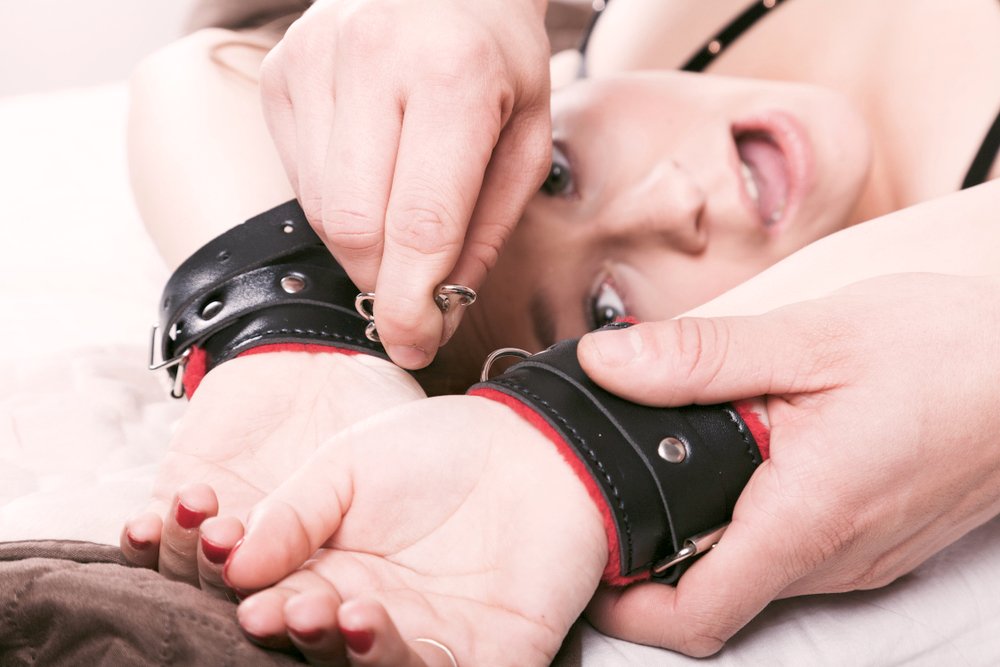
Our Essential Guide to BDSM Safe Words
Most people are familiar with the basic concept of safe words. One person says “cherry” or “elephant” or “pineapple peanut butter cream” or whatever, and the other person stops what they’re doing. But, as writer Abi Brown explains, there's a bit more to the concept than that.
Do all BDSM relationships need safe words?
The official party line of the BDSM community is that any kinky sex - no matter how gentle - should only be undertaken with a pre-agreed safe word. However, in practice, it’s a bit more complicated than that.
You’ll find some couples who take the view: if you communicate well and trust each other, safe words shouldn’t be necessary. This is most relevant to people who focus more on impact play and bondage than on very psychological and 'headspacey' BDSM. Of course, it doesn’t hold up in a situation where someone might say “no” or “stop” without actually wanting the play to end.
Then some people practice what is sometimes known as 'edge play' (a term that seems to have at least three different accepted meanings in the BDSM community). Kinky sex where you’ve explicitly agreed in advance, for that session, there is no safe word - this can be fascinating from a psychological perspective as it adds a particular frisson for a lot of people who are into consensual non-consent. This should only happen between two people who trust each other and have discussed it a great deal beforehand.
What distinguishes both of these exceptions, though, is that all involved have talked it over amongst themselves openly. In kinky sex, having a safe word should be the default - and playing without one the exception.
Choosing BDSM safe words
The stereotype is that you pick something slightly silly. Something that you’d never say in the usual course of sex. There are benefits to this approach: it will certainly stand out to the person hearing it as unusual.
However, there are also a few drawbacks. I, for one, would feel awkward and self-conscious about using such a safe word. They’re also much easier to forget in the heat of the moment, as they are yet another thing to discuss during negotiations with any new partner(s), you run the risk of not thinking of one till it’s too late. This is especially a problem in a busy fetish club or play party environment.

The solution?
Have a couple of different options that are widely accepted throughout the community that people can default to and always be understood. We’ve got 'safe word' and 'red'. Pretty much anyone involved in BDSM will know what you mean if you use them.
If you’re playing with someone and they say either ‘safe word’ or ‘red’ STOP WHAT YOU’RE DOING. You should do this regardless of any discussion you’ve had before - unless you were both very explicit, beforehand, not to use a safe word in a scene. Even then, it’s still a good idea to check in. They might have explained in negotiations that they wanted to use those words: as part of the psychological kink and are enjoying you not responding to them.
When is it appropriate to use a BDSM safe word?
The trite answer to this is “whenever you feel the need to” - and that’s true, of course. In practice, though we all struggle with this from time to time.
My article Five Bad Reasons Not To Safe Word looks at some of the problems people might have in this regard. Some people don’t safeword particularly often. Over ten years and numerous Dominants, I believe I’ve used one precisely four times. I’ve done a lot of consensual non-consent play. One of my favourite things about kink is knowing I’ve weathered through something that wasn’t easy for me. Not everyone wants to play that way, and that’s okay. Other people use them quite frequently.
- When you’re only just starting, it can be a good way of exploring what you do and don’t want, safely.
- The dominant partner can experiment safely. Knowing that you’ll tell them if you want them to stop or slow down.
-
There are also people who love to be taken right to the very edge of their boundaries - this can only work if they’re able to communicate when those boundaries have been crossed.
Then, of course, there’s the question of variable *** thresholds. Everyone’s ability to process *** fluctuates. People who are very into impact play need to be able to let their dominant know where they’re at.
Whatever your reason for using a safe word, the important thing is that you know you can trust your partner(s) to respect it and they won't make you feel uncomfortable for using it. This is one of the fundamental tenets of consent in BDSM relationships. It’s vital for you and everyone you play with to be on the same page before you begin.
When the boundaries are crossed - use your safe word! Image: via Shutterstock.com
Are there times when a safe word isn’t enough?
Of course, there are a few circumstances when a verbal signal isn’t practical. What about when you’re gagged or engaged in breath play? In situations like this, you’re going to need to agree on a non-verbal way to communicate. A signal to your partner that works in the same way as saying ‘safe word’ or ‘red’ or ‘too much’ or whatever else out loud. A few examples, to give you somewhere to start from:
1. Click your fingers three times, or repeatedly until you’re sure your Dom has got the message - a non-verbal option to which I default. It’s not perfect for bondage (you might not be able to get your hand in the right position) or in fetish clubs (where it might not be audible over the music). In many situations, it works well and doesn’t feel too awkward.
2. Get the submissive to hold something that will make a noise if dropped. Most bondage arrangements leave your hands just about free enough for this (unless you’re wearing bondage mittens).
3. I habitually wear a lot of jangly metal bracelets, so in my case, it’s usually those. Of course, it can be anything, from a handful of dice to a rattling dog toy! The major drawback of this method is that you might drop it by accident, which I did once.
4. Even when you can’t speak, you can make three short noises in the back of your throat. A sound a bit like 'nnn nnn nnn', which is much easier to do than to describe, and is a good all-rounder. It’s as audible as s***ch, it’s not affected by bondage and you can do it no matter what’s happening to your mouth and throat at the time.
These are just ideas, of course. Come up with your own that fit your specific requirements. Whatever you decide to use, it’s vital that you discuss it in advance, and that the choice you make works well for both you and your partner(s).
Is there an intermediary stage before using a safe word?
Personally, I am a huge proponent of using a signal to say “check in with me” rather than “this is the end of the scene”. I find the latter to be a bit manipulative on the part of the Dom who decided it, to be honest. Communication is key no matter what’s going on. I mentioned earlier that one of my current partners sometimes asks me “too much?” when he wants to check in. That’s not the only way of doing it.
‘Red’ became a standard safe word as a result of the traffic light metaphor. I’ve also had Doms who will periodically ask me for a colour, which acts as a good reminder for me. It also gives me a chance to say ‘yellow’ (“this is getting a bit difficult and I might need you to ease off a bit”) or ‘green’ (“I’m fine”). One of my earliest Doms would sometimes take my hand and squeeze it in two quick pulses. If I squeezed back, he’d know I was okay. If I didn’t, he’d check in with me verbally.
What if BDSM safe words are underused, misused or ***d?
Before I deal with this, I’d like to make one thing absolutely crystal clear: If someone uses a safe word and it is ignored, anything that happens after that is a consent *** at best and, at worst, ***.
If you feel that your limits, boundaries, and safe words are not being respected: you are in an abusive relationship. Something that people may not have expressed to you clearly in the past. If you're failing to recognise the limits, boundaries and safe words of your partner(s) you need to deal with your shit ASAP.
The corollary to this is that if you don’t express your limits and boundaries, your Dom has every reason to believe that the encounter remains consensual. So for the love of God, use a safe word if you need to. I’ve made the mistake of not doing so when I should have, and it was nevertheless an unpleasant experience I am not keen to repeat.
If you’re a Dominant who feels like their submissive partner uses their safe word too often, I have some advice for you: get your head out of the sand. Something isn’t right in this sexual relationship.
You need to sit down together and have a thorough discussion about how you both feel and what you both want. It may be that your partner(s) are worried they can’t trust you not to run roughshod over their boundaries, for example. Which is something you need to address together if you want the relationship to work; it may also only be that they fantasise about BDSM a lot but are made nervous by it in practice. Again, this is something you can approach jointly.
Abi Brown is a freelance writer and general pen-for-hire devoted to sexual deviancy, far-left politics and wearing too much jewellery.

What are your top safe word tips? Join the discussions about hard and soft limits in the Fetish.com forum.

Cover Image: Dr Faustus via Flickr.com CC BY 2.0 license